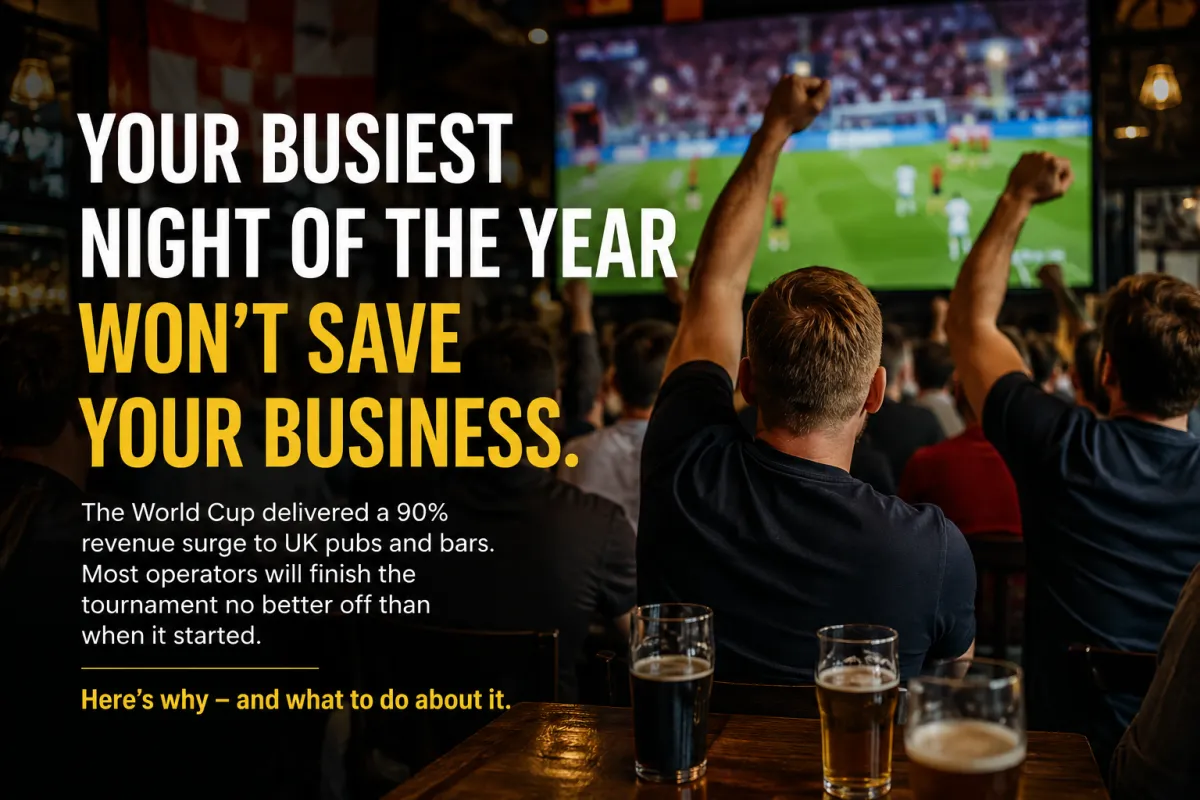
Your Busiest Night of the Year Won't Save Your Business
The World Cup delivered a 90% revenue surge to UK pubs and bars. Most operators will finish the tournament no better off than when it started. Here is why, and what to do about it.
By Saladin Nadir· Offer Catalyst
Thousands of pubs across the UK are celebrating record sales during the World Cup. But many will discover that record sales don't always mean record profits
The Belief That Keeps Operators Stuck
I hear this all the time if I can just get more customers in, everything else will fall into place. More people, more sales, more profit. It sounds good, but in reality, this is one of the costliest beliefs a business owner can have.
Chasing higher volume is not a real strategy. It is just a temporary boost.
The 2026 FIFA World Cup proved this on a large scale. Data from Square’s point-of-sale systems, tracking millions of UK transactions from 11 to 27 June, showed that revenues at pubs and bars rose by 90% during England matches compared to normal times.
Late night games between 10pm and 1am saw transactions go up by 121%. On 23 June, when England played Ghana, daily sales increased by 91%. The Morning Advertiser also reported that 6.8 million extra pints were poured during the group stage alone.
Credible numbers. And a lot of the operators who celebrated them will find themselves in exactly the same place on 20 July, the day after the final, as they were on 10 June, the day before it all started.
Busy is not a business model. A demand surge is an opportunity. What you do with it is a decision.
This article isn’t actually about the World Cup. Instead, it looks at what happens when you set up your business to make the most of every busy period, every full house, every surge in demand, and every exceptional week. That’s what Offer Catalyst focuses on: not chasing after events, but being prepared for them when they arrive.
Why Most Operators Miss the Opportunity.
When something like this happens, most operators go into survival mode. They bring in stock, organize the rota, set up screens, and run a special offer. On the night, the main aim is to get through it, keep up with demand, make customers happy, and support the team when things get busy.
All of this matters, but it is not the same as having a real business strategy.
The operators who are getting ahead during this World Cup are asking themselves three questions that many others are not:
1. What is my profit margin per customer, not just my total revenue each night?
2. How many of these new customers am I actually keeping for the long term?
3. What is my plan to bring in customers once the tournament is over?
If you cannot answer all three of these questions, you are working much harder than you need to and getting less than you deserve.
If you cannot answer all three questions, you may be working harder than you need to and not getting the results you deserve.
Margin Per Customer: The Number That Actually Matters
Revenue tells you how busy your business was, but margin shows the profit you actually made. These are not the same thing. When business picks up, the gap between them often widens, not narrows.
Here’s a simple example. On a normal Wednesday, a pub might see each customer spend about £12, with a 65% gross margin on drinks. That works out to around £7.80 gross profit per person. On a World Cup night, the pub could have twice as many customers, and each one might spend £18 since they stay longer and order more.
At first, this sounds great. But if most of the extra sales are from cheap draught lager, which fans often buy in rounds, the gross margin could fall to 58%. So even though revenue goes up, profit per customer goes down. If you also need more staff at higher wages, the actual profit for the night might not be as high as the revenue suggests.
There’s a straightforward fix. Before a big event, identify which products have the best margins and ask your team to focus on selling them.
You can make specials and bundles around them. Premium cocktails, sharing platters, bottles of wine, and premium spirits usually have better margins than regular draught. When your team knows this and acts on it, a busy night can turn into a truly profitable one.
Capturing Customer Data: The Asset Most Operators Leave on the Table
Let me ask you this: after your busiest match night, how many of those customers could you actually reach out to the next day?
If your honest answer is almost none, that’s a real problem. No matter how busy you get, it won’t solve this. You’re relying on people to return on their own, find you on social media, or just happen to walk by. In a competitive market, that puts you at a disadvantage.
Big events are a rare chance to collect customer details because people are happy, engaged, and in a good mood. They’ve just enjoyed themselves. Right after a winning penalty or at half-time, when someone orders another round, is probably the best time all week to ask for something in exchange for a reward.
Here are three easy ideas that work:
Set up a digital loyalty prompt at checkout. Many POS systems let customers join a loyalty program right as they pay. It takes just one tap and very little effort. People are much more likely to say yes when they’re already in a good mood.
Try a QR code prize draw. Place a tablet on the bar with a simple form for name and email, and one click to enter for a chance to win. The prize doesn’t have to be expensive. The customer list you build is much more valuable.
A follow-up offer on the receipt. Printed or digital receipts can carry a simple add-on offer. Printed or digital receipts can include a simple incentive: 'Come back for the quarter-final and your first round is on us when you book.' When you consider how much a returning customer spends, the cost of one free drink is worth it. Use customer data as a business asset, and an instruction to your team to make it part of how they work.
Turning a One-Off into a Regular: The Retention Conversation
The World Cup wraps up on 19 July. Right now, I’d be asking: how do you keep the momentum going between the tournament and August?
If a customer visits your venue twice, they’re much more likely to become a regular than someone who only comes once. Customer retention data is clear: it costs much more to attract a new customer than to keep one you already have.
Every first-time visitor on a match night is a chance to build loyalty. That chance disappears as soon as they leave without a reason to return.
You don’t need a loyalty program, a CRM system, or a big marketing budget to solve this. What matters is your intention and a simple prompt. It could be a card on the table, a quick word from the server, or a note on the receipt. The exact action isn’t as important as making sure you do something.
There’s still time with the remaining matches. Choose a post-tournament event, like a summer quiz or a live music night, or something special for members, and tell customers about it before they leave. Give them a reason to say yes to their next visit while their good experience is still fresh.
What the Prepared Operators Did Differently
Two examples from this tournament are worth considering, not because they are impossible to achieve, but because they show what deliberate commercial thinking looks like in real situations.
Young's Pubs introduced order-and-pay technology at tables across their locations and added mobile bars to reduce queues. This led to faster service, more customers served, and fewer lost sales from people leaving busy bars. Importantly, digital ordering also creates a data trail. Every customer who orders through a device can be reached for future marketing. Young turned a practical challenge into a way to attract new customers.
Marston's changed 36 locations to the Grandstand format, offering match-themed food specials like a 'hat-trick burger' and a 'vindaloo burger.' The idea is simple. Special menu items available for a short time and at a good profit encourage people to order food with drinks, raise the average sale, and provide content for social media that spreads the word about the event at no extra cost. These specials also give customers a reason to return for the next game.
Neither of these examples needed huge resources. They just took planning and clear commercial thinking before the tournament started. The takeaway is not to copy their actions, but to adopt their way of thinking.
The One Degree Shift Method
At Offer Catalyst, we use the One Degree Shift method as the foundation for building a profitable, lasting hospitality business. The idea is simple. You don’t usually need a big overhaul to see real improvement. Instead, a series of small, deliberate changes, each one small on its own, can add up to something significant over time.
A one-degree shift in average transaction value. A one-degree improvement in gross margin. A one-degree increase in how often customers return. None of these changes feels dramatic at first. But over a quarter, they can reshape your business.
The World Cup shows how this works in real life. The operators who finish the tournament in a stronger position are not always the ones with the most exciting match nights. Instead, it’s those who made small, thoughtful changes, like briefing their team on margin, positive products, adding a data capture step to the payment process, or giving new customers a simple reason to return. Each of these steps takes just one decision and about an hour to prepare. Together, they help the tournament leave a lasting impact on the business, not just a good memory.
That is what small operational improvements look like. Not a revolution, just a degree.
Work out your real gross profit.
Identify your three most profitable products and ask your team to focus on selling these during the upcoming fixtures. Make your instructions clear. Rather than saying 'push premium items,' tell them to 'offer the [specific product] when someone orders a second round.'
Set up a way to collect customer data during payment or service before the next match. You could use a loyalty prompt, a QR code for a prize draw, or a simple email sign-up at the bar. The key is to make sure you have at least one method ready.
Work out your real gross profit from the last match night, not just the total sales. Remember to include the mix of products sold, staffing costs, and any waste. If the numbers surprise you, let your team know before the next fixture.
Plan a post-tournament event and let customers know about it before they leave the next games. Give them a date, a reason to come back, and a simple way to book. For example, you can say, 'We are hosting a summer screening night on [date]. Shall I put your name down?' This approach is free and works well.
Look over your stock management from the last match night. Did you have too much or too little stock? What was wasted, and what ran out? Making one change before the next fixture can help both your profit margin and your customers’ experience.
Ready to Find Your Hidden Profit Opportunities?
If you’ve had a busy few weeks but your profits don’t match what your revenue suggests, it’s worth talking about why.
An Offer Catalyst assessment pinpoints where your business is losing margin, shows how small changes to your offer can boost customer spending, and highlights operational tweaks that build results over time.
This isn’t just a report. It’s a hands-on session with a hospitality advisor who understands the industry. You’ll leave with a clear, prioritized action plan you can start right away, without needing extra help or a big investment.
Book your Offer Catalyst assessment at www.offercatalyst.com or contact Saladin Nadir directly. Your busiest season should leave your business stronger. Let’s make sure that happens.