How to Calculate Your Break-Even Point (Hospitality Business Guide)
How to Calculate Your Break-Even Point
(And Why Every Hospitality Business Owner Needs to Know This Number)
By Saladin Nadir
Introduction
Your break-even point is the minimum amount of money your business needs to bring in just to cover its costs. It is not enough to make a profit, pay yourself well, or grow your business.
It is simply what you need to survive. This number marks the difference between losing money and breaking even.
Every choice you make about pricing, staffing, opening hours, and marketing should be based on this figure.
If you do not know your break-even point, you are running your business without a clear direction.
You could be busy every shift and still lose money. You might turn down bookings because you think you are at capacity, when in fact, taking more could help you.
Or you might open three days a week but only break even on two, so the third day just adds costs without any benefit.
The calculation itself is straightforward. The real value comes from knowing what that number means for the decisions you make every day.
Once you know that number, you can make those decisions with much more confidence.
The Real Problem Behind the Search
When hospitality business owners ask how to find their break-even point, they want more than just a formula. They are really thinking about something bigger and more urgent.
What they really want to know is whether they are making any money. How much do they need to earn just to keep the business running? If they have to close for a day, lose a contract, or face a slow month, can the business cope?
After more than three decades in the hospitality industry, including running my own businesses, I learned this lesson the hard way.
At first, I didn't know my break-even number either.
Like many owners, I thought being busy meant we were successful, not realising the importance of the numbers. Looking back, not knowing this one figure probably cost me more than anything else.
Over the years, I've seen many hospitality business owners make the same mistake. They know when the restaurant is busy, but they don't know the exact revenue they need to avoid losing money.
What the Break-Even Point Actually Means
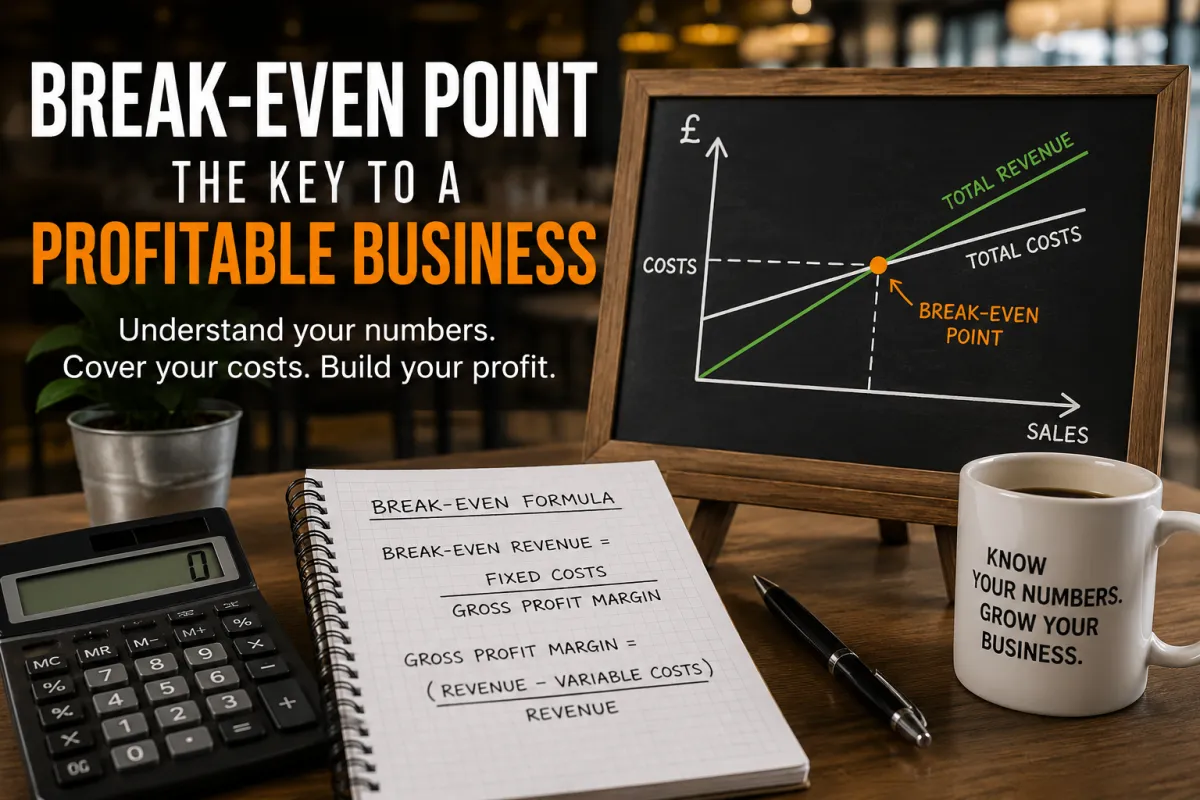
The break-even point is when your total income matches your total costs. If you earn less than this, you have a loss. If you earn more, you make a profit.
To work out your break-even point, you first need to separate your costs into two groups: fixed costs and variable costs.
Fixed Costs
Fixed costs stay the same no matter how much money you make. Whether you have 10 customers or 200, these costs remain unchanged.
Some examples of fixed costs in hospitality are:
·Rent or mortgage payments
·Business rates
·Insurance premiums
·Loan repayments
·Management salaries (salaried, not hourly)
·Utility standing charges
·Software subscriptions and POS system fees
·Accountancy and professional fees
Variable Costs
Variable costs change in direct proportion to your revenue. The more you sell, the higher your variable costs.
Examples in hospitality include:
·Food and beverage costs
·Hourly wage labour
·Packaging and disposables (for food-to-go)
·Laundry and linen (for hotels)
·Payment processing fees
·Delivery platform commissions
It is important to understand this difference because it affects how your business responds when revenue changes.
Fixed costs stay the same even if you close for a day, while variable costs go down if you serve fewer customers. You need both numbers to work out your break-even point.
The Break-Even Formula
The standard break-even formula is:
Break-Even Revenue = Fixed Costs ÷ Gross profit Margin
Gross Profit Margin shows what percentage of each pound you earn is left after you pay your variable costs.
You can use what's left to pay your fixed costs, and anything beyond that becomes your profit.
Gross Profit Margin = (Revenue − Variable Costs) ÷ Revenue
A Real Restaurant Example
Here's how the calculation works for a typical restaurant
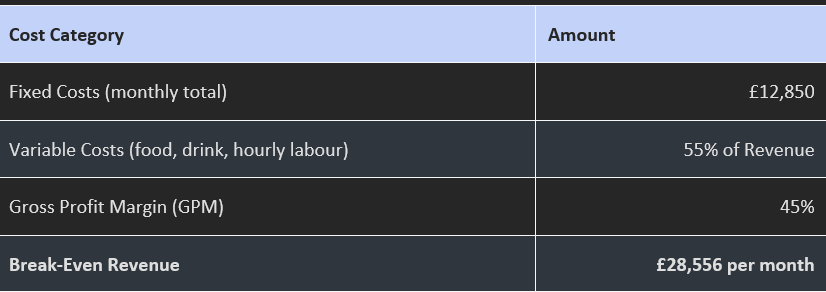
Imagine you run a 50-cover restaurant. Your numbers for a typical month look like this:
Monthly Cost Structure, 50-Cover Restaurant
Step 1: Calculate the Gross Profit Margin
Variable costs are 55% of revenue, so the Gross Profit Margin is:
Gross Profit Margin = 100% − 55% = 45%
This means that for every £1 the restaurant makes, 45 pence go toward fixed costs. After covering those, any extra becomes profit.
Step 2: Calculate the Break-Even Revenue
Break-Even Revenue = £12,850 ÷ 0.45 = £28,556 per month
The restaurant needs to make £28,556 each month to break even. If it brings in more, it makes a profit. If it brings in less, it loses money, even if the restaurant looks busy.
Translating Break-Even Into Daily and Weekly Targets
Translating Break-Even Into Daily and Weekly Targets
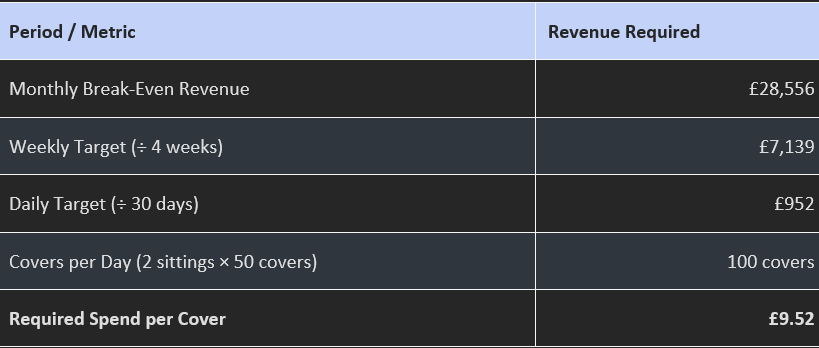
A monthly break-even figure is useful, but it becomes more actionable when you break it down further
Once you look at the numbers, things become clearer. For example, if a restaurant serves two sittings of 50 people each day, it needs each customer to spend just over £9.52 to break even.
If the average main course is £18 and about a third of diners order a starter, you can quickly see from the numbers whether you are meeting your goals.
Break-Even Targets, 50-Cover Restaurant
A Café Example
Let’s look at a simpler business.
A café owner is trying to understand why they feel busy but never seem to have money
Monthly Financial Overview, Café
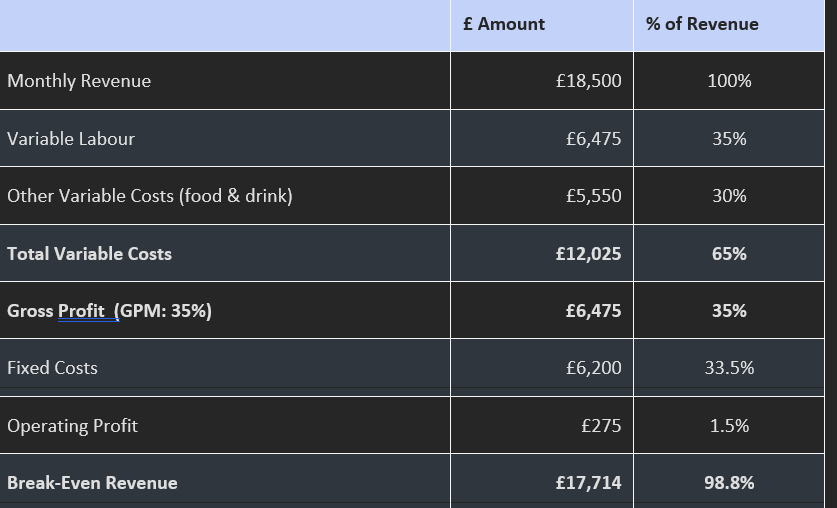
This café brings in £18,500 each month and needs £17,714 just to break even.
At first glance, things seem okay. But take a closer look at the labour costs.
Variable labour alone takes up 35% of revenue, and there are also fixed staff costs included in that £6,200.
This leaves the business with almost no margin for mistakes.
If the café has a slow week, needs to cover for a sick staff member with expensive agency help, or faces a quiet January, it can easily fall below break-even without the owner noticing.
This is how businesses can fail quietly and unexpectedly.
A Hotel Example
In hotels, break-even calculations usually look at occupancy instead of just revenue, but the main idea stays the same.
Imagine a boutique hotel with 20 rooms, where the average room rate is £110. The hotel has monthly fixed costs of £38,000.
For each occupied room, variable costs like cleaning, laundry, and breakfast add up to £22 per night.
Break-Even Analysis — 20-Room Boutique Hotel
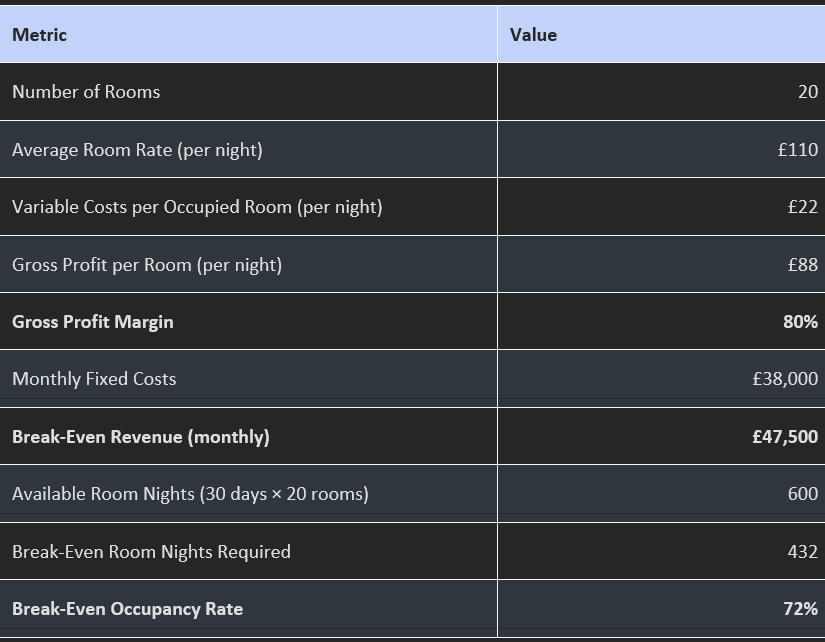
This hotel must reach 72% occupancy just to break even. That figure comes before the owner pays themselves, covers any debt, or invests back into the property.
In a competitive market, this is a tough target, which helps explain why the business always seems to be chasing revenue.
Your break-even point isn't fixed. It moves whenever your costs or prices change.
If your rent increases by £500 a month, your break-even revenue rises by about £1,111 if your Gross Profit Margin is 45%.
This happens even if nothing else changes in your business. A rent review that looks manageable at first can actually mean you need to bring in thousands more in revenue.
If you increase your prices by 10%, and your volume stays the same, your gross profit margin improves, and your break-even point goes down.
You are suddenly profitable at a lower revenue level. Pricing decisions and break-even analysis are deeply connected.
That's why I always tell hospitality owners that your break-even point is a living number.
You should check it often, especially when your costs change, you renegotiate your lease, or you think about raising prices.
How to Reduce Your Break-Even Point
Once you know your break-even point, you may want to find ways to lower it. Here are two main options.
1. Lower your fixed costs
Review each fixed cost carefully. Can you negotiate a better lease? Could you switch to a different insurance plan?
Are you paying for software you rarely use? Even small savings can help lower your break-even point.
2. Increase your gross profit margin
You can improve your Gross Profit Margin by increasing your prices or reducing your variable costs. For example, you might reduce food waste by 5% or get better terms from your suppliers.
Shifting your menu toward higher-margin dishes can also improve your Gross Profit Margin and lower the revenue needed to break even.
For example, a 2% improvement in food costs in the restaurant example above saves about £840 per month and lowers the break-even point by more than £1,800. Even small changes in variable costs can add up over time.
The One Degree Shift Method
When money gets tight, many hospitality owners try to boost revenue by bringing in more customers, running extra promotions, or hosting more events. While revenue matters, it is not always the best place to start.
Knowing your break-even point changes how you think. Instead of just wondering how to attract more customers, you begin to ask better questions: Am I pricing correctly for the costs I carry?
Am I pricing correctly for the costs I carry?
Which parts of my operation are eating into my Gross Profit Margin?
Am I covering my fixed costs spread evenly, or is one day of the week doing all the heavy lifting?
If I lose a key contract or a regular client, what happens to my break-even position?
Action Steps
Start with these six steps this week.
1Write down all your fixed costs for the month. Make sure you include every item. Use your bank statement to get the exact numbers instead of guessing.
Figure out your average variable cost percentage. Add up your food and beverage costs and hourly labour costs, then divide that total by your revenue from the past three months.
Now divide your total fixed costs by your Gross Profit Margin. For example, if your Gross Profit Margin is 45%, use 0.45 in the formula. This gives you your break-even revenue.
Take that number and figure out what it means for your weekly and daily targets.
Check your current revenue against that target. Are you making more than your break-even point, or less?
If you are below your target, look for the quickest way to lower your fixed costs or increase your Gross Profit Margin.
Conclusion
The break-even point is a simple idea, but it is one of the most important numbers in your business. Many hospitality owners have never worked it out correctly. I was one of them.
Once you know your break-even number, you stop guessing and relying on instinct. You can make choices about pricing, staffing, opening hours, and promotions based on what your business really needs, not just on how busy it seems.
Being busy does not always mean you are making a profit. High revenue does not always mean success. Profitability starts when your revenue is regularly above your break-even point.
Workout your break-even point today and write it down. Keep it somewhere you can see it often. Use that number to guide every decision you make in your business
Continue Your Financial Journey
Knowing your break-even point is an important first step, but it is only one part of understanding the financial health of your business.
Long-term success in hospitality is not just about knowing one number. It depends on understanding how pricing, break-even, cash flow, food costs, labour costs, and profitability all work together as a complete financial system.
When these parts are in sync, your business can make steady, lasting profits. If they are not, even a busy business can struggle without warning.
The Small Business Financial Training helps hospitality business owners build a strong financial foundation, step by step. It gives you practical tools you can use right away in your business.
As part of the training, you'll also receive practical bonus resources, including the Break-Even Calculator, Profit Dashboard, Cash Flow Templates, Worksheets and Checklists, to help you put what you learn into practice.
If you want to strengthen your hospitality business’s finances, you can learn more and find out more about the Small Business Financial here